
RANGE OF MOTION
In spring 2025, at a moment when so many of us were stiff with fear, rigid with rage, and locked into our positions, we at DS4SI suggested considering something counterintuitive. When it feels like we can’t think and we can’t move, we suggest that “can’t think” and “can’t move” are in fact deeply connected. Instead of the binaries offered to us, we believe we need a range of motion. That range of motion, that movement that breaks a binary, can also help us rethink it. Instead of going harder, locking in, and ramping up our righteousness, we need to explore the uncertainty, the not-knowing. The thirdness. The weird, the poetic, the perverse, the liminal.
So we called on the ones who rigorously and joyously know that there are many ways to move a muscle, to take up space, to shape and stretch a thing, to feel and express a thing, to shift or bend a thing.
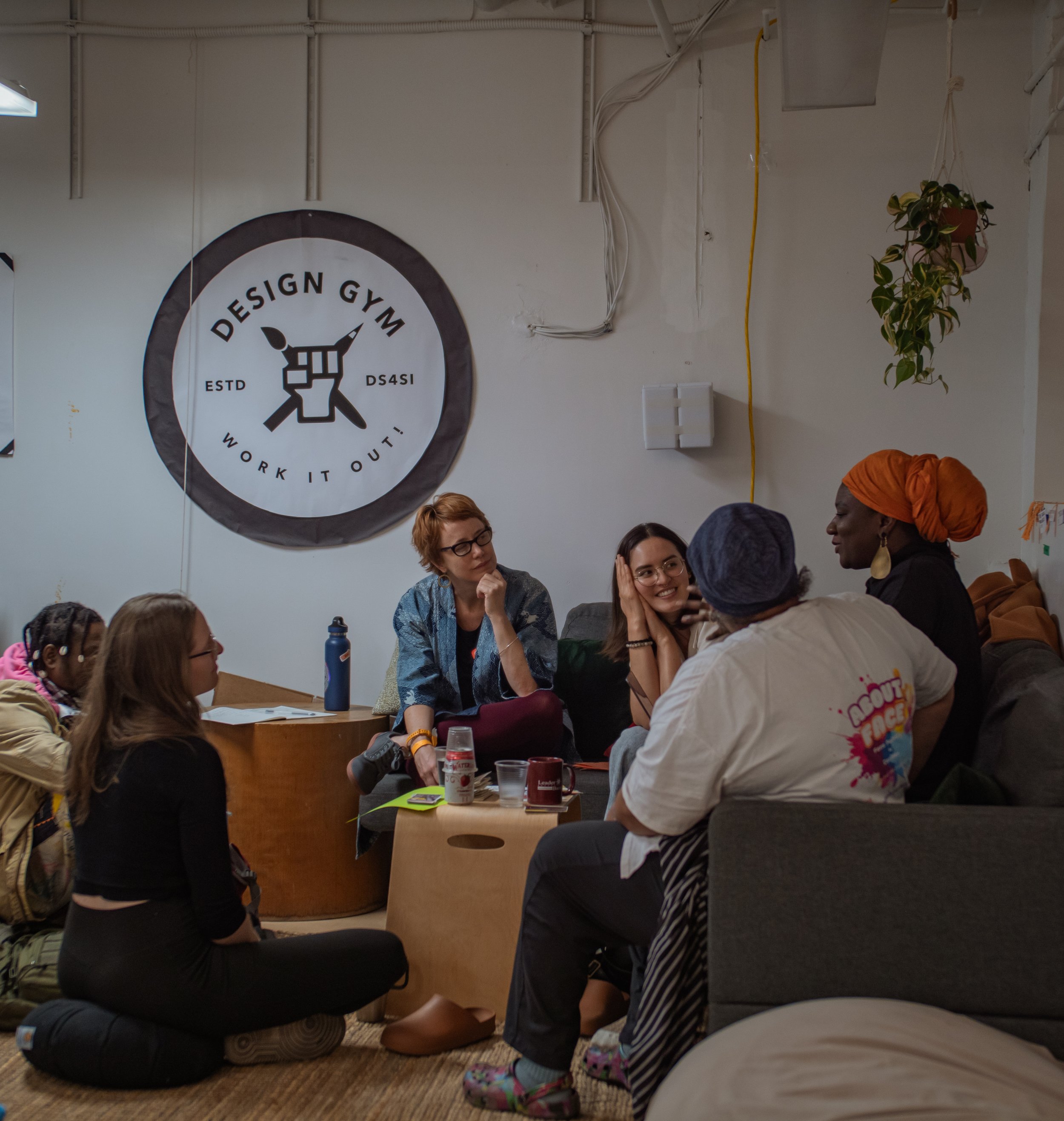
The Design Gym put this range of motion into practice in three ways. Open Gym hours offered weekly drop-in time to work on ideas and prototypes, Design Teams deepened their process through a series of Saturday workshops, and Social Making Thursdays brought neighbors together to learn hands-on skills while shaping the Design Gym itself. All programs were free and open to all.
Open Gym
Every Tuesday and Friday from 4 to 7pm, Open Gym gave Design Teams the chance to work on an idea, a project, or a question, wherever they were in the design process. Participants used Design Gym kits to tackle a problem, got feedback on intervention ideas, or simply found a quiet place to work on a prototype, with Design Gym staff ready to support.
Design Teams
Led by Lori Lobenstine and Kenneth Bailey across three Saturdays, Design in Practice brought our Design Team members together to rigorously engage in the design process, from divergence through convergence. The workshops covered everything from inspecting the problem frame to gathering insights from divergent thinkers to materializing ideas through rapid prototyping.
Social Making Thursdays
Social Making Thursdays treated making as a social process of learning, creating, and shaping our shared environment together. The season opened with Introduction to Palestinian Embroidery: Stitching Solidarity with N.A. Mansour, a hands-on introduction to embroidery as a practice of culture, memory, and solidarity. Tanya Nixon-Silberg then led Clothes Mending & Repair as a Radical Practice, where participants patched favorite jeans and creatively restored shirts, disrupting capitalism’s cycle of continuous production and overconsumption by extending the life of their clothes instead of replacing them.
The last two classes turned skills into infrastructure for the Design Gym. In Sewing Cushion Covers with Anulfo Baez, participants learned the basics of sewing while measuring, cutting, pinning, and stitching large cushion covers for the space. The semester closed with Constructing the Pillars with Mister Maria, a barnraising-style build where beginners and experienced builders measured, cut, assembled, and installed two new kit stations designed for both storage and interactive instruction. No prior experience was needed for any of the classes.